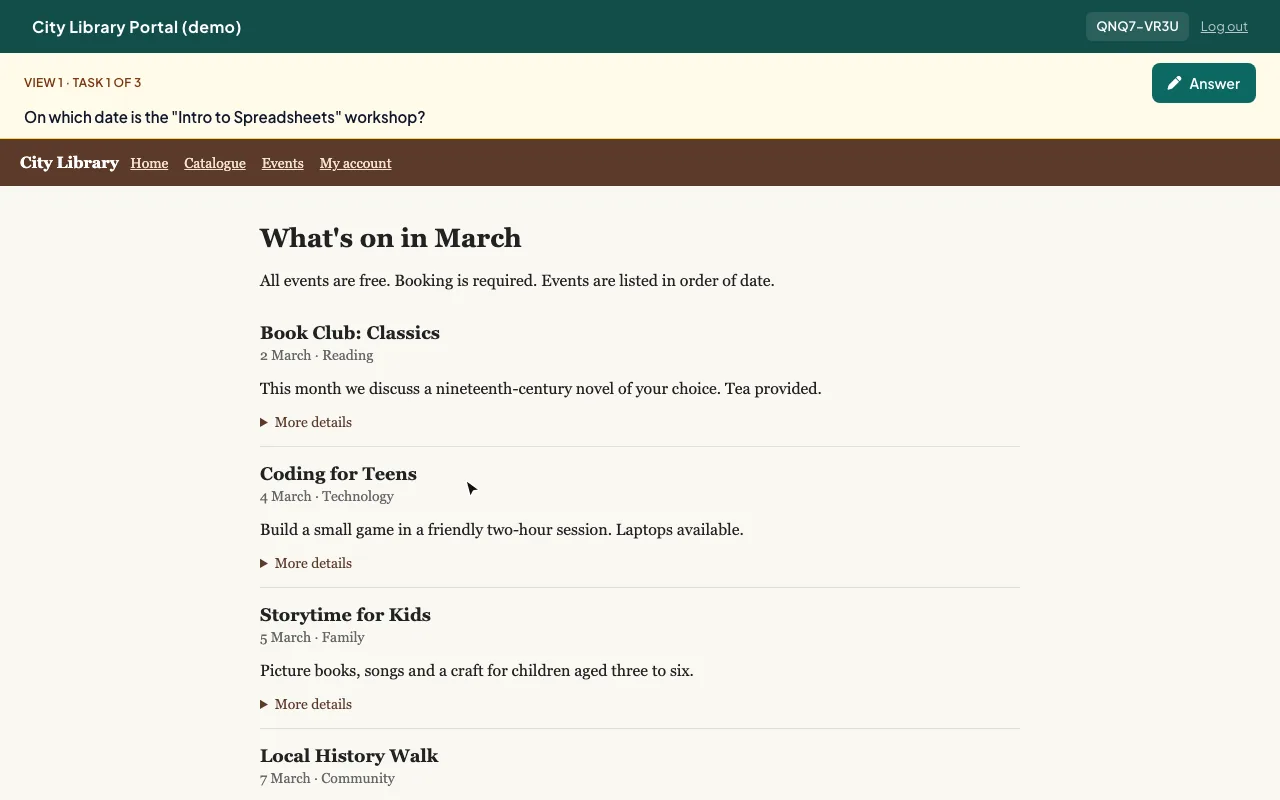
Real tasks on your real prototypes
Share one link. Participants join with a code, an email address or anonymously, on a phone or a laptop, with no account and nothing to install. Every task records time, success, first click and click path.
UX Testbench is an open-source tool for surveys, A/B prototype tests, card sorts, tree tests and first-click tests. Self-host it, and get results that are honest about what the numbers can and cannot tell you.
No credit card. MIT licensed. Self-host it and we never see your data.

Share one link. Participants join with a code, an email address or anonymously, on a phone or a laptop, with no account and nothing to install. Every task records time, success, first click and click path.
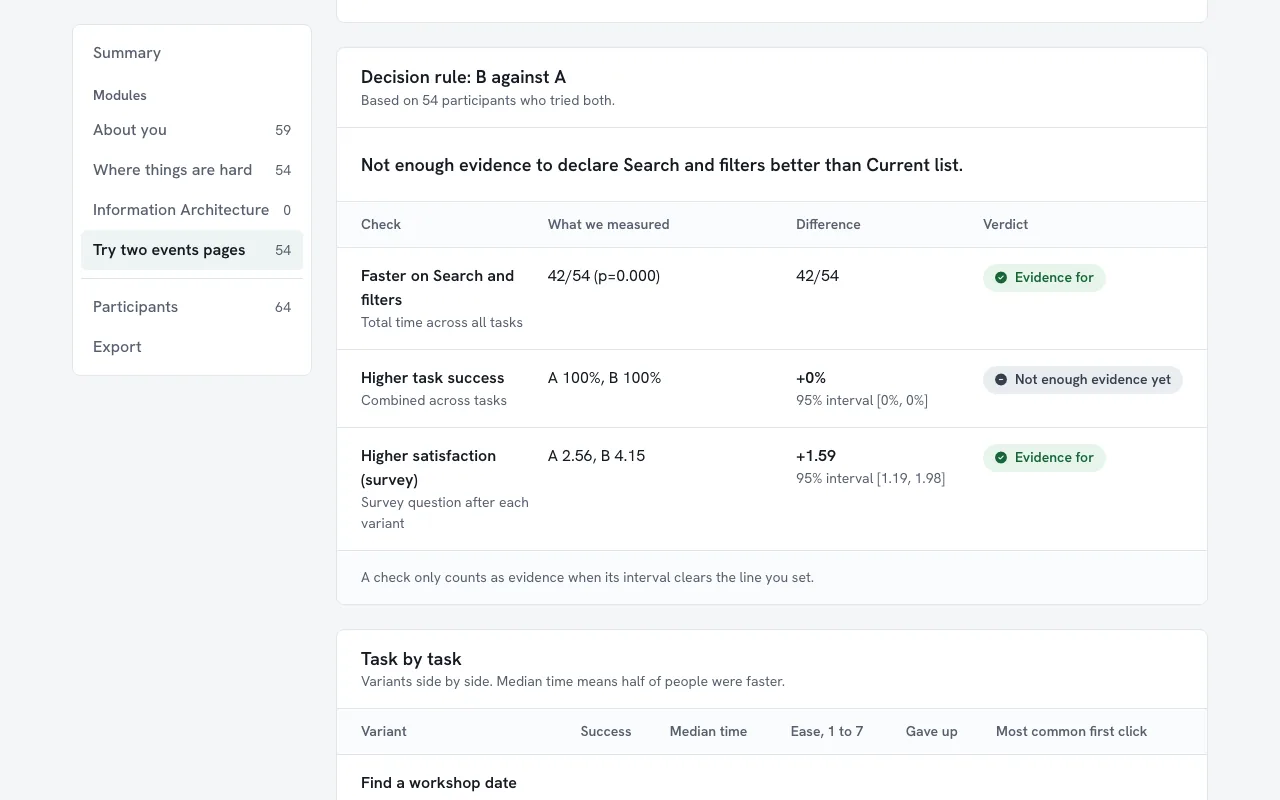
Most tools run a t-test on eight people and print a winner. UX Testbench uses an exact sign test and bootstrapped intervals, and every verdict shows its p-value and how many paired participants it rests on.
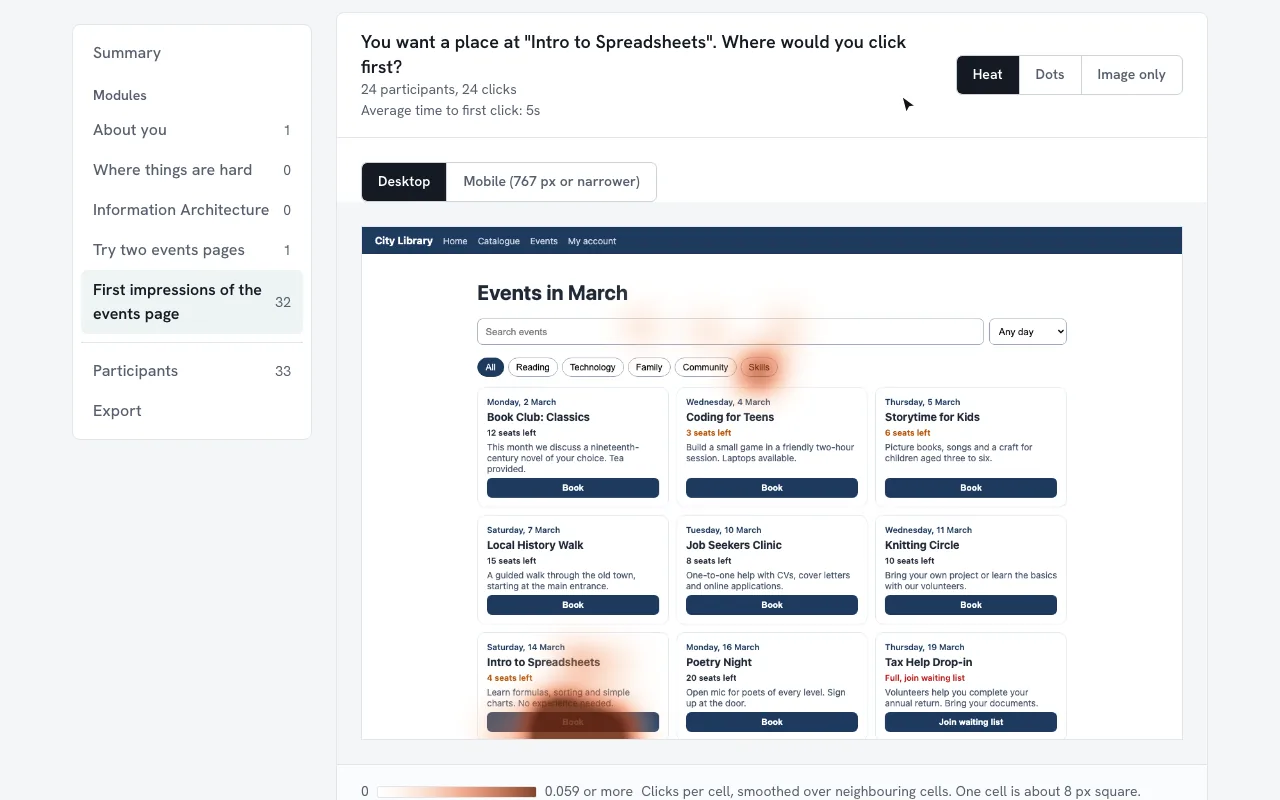
First-click tests turn every click into a heatmap over your screenshot, split by desktop and mobile. Below five participants it shows each click on its own, because a density map from so few would invent a pattern.
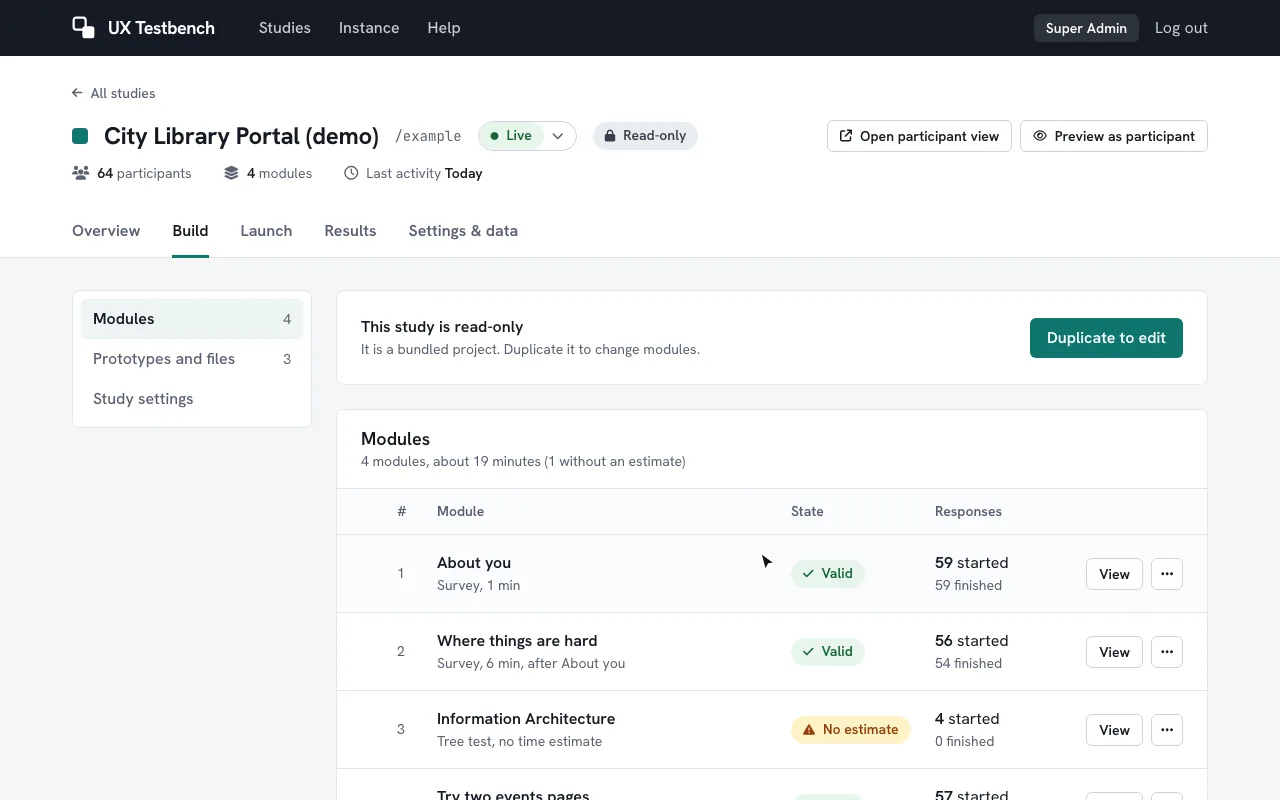
Chain surveys, tests and screeners into one study in the Studio, or edit the YAML and keep it in version control. A scratch copy is validated before anything goes live, so a typo cannot take a running study down.
Likert scales, multiple choice, matrices and open text, with conditional skip logic.
Serve two HTML prototypes and record time on task, success, first click and click path.
Open, closed or hybrid sorts, with similarity matrices and dendrograms.
Text-only hierarchies measuring directness, success and backtracking.
Screenshots with click heatmaps and first-click success, by device.
Prerequisites and audience rules decide who sees which module, and when. One study instead of four.
No participant panel resold, no model trained on your data, and no analytics script following the people who help you.
# clone, install, run
$ git clone https://github.com/syaifullah18/ux-testbench
$ cd ux-testbench && pip install -r requirements.txt
$ python -m testbench run

  * Running on http://127.0.0.1:5000
* No database server, no container, no build stepYes. It is MIT licensed, so you can self-host it forever at no cost. The hosted version is free while it is in beta.
Yes. The MIT licence allows commercial use, including running studies for clients.
Only the study link. It works on a phone, needs no account and no install, and participants can stop and resume later.
On your own server. Every study gets its own SQLite file, and with LOCAL_ASSETS=1 participant pages contact no third party at all.
Fewer than you might think for a direction, more than most tools admit for a decision. The report says "not enough evidence yet" until the sign test has enough paired participants to back a verdict.
Open an issue or a pull request on GitHub. CONTRIBUTING.md in the repository explains how to run the tests and what a good change looks like.
Free while it is in beta, and free forever if you host it yourself.